
Urban heat islands and the global need for cooling strategies
Italian cities are turning into true summer furnaces. The urban heat island effect, which raises the temperature of densely built areas compared to the surrounding countryside, has become a recognized emergency among scientists and local administrations. Asphalted streets, concrete roofs, and a lack of green or reflective surfaces transform cities into thermal accumulators that absorb solar energy during the day and release it after sunset, maintaining excessively high nighttime temperatures.
What is passive cooling?
According to a study by Italy’s National Research Council (CNR), all major Italian cities show strong thermal anomalies. In Rome, for example, the urban heat island intensity reached 4.6 °C during the hottest summer nights, directly affecting energy consumption. Demand for urban cooling increased by up to 81% on the warmest nights, worsening living conditions. A 10% rise in sealed surfaces can lead to a temperature increase of nearly 4 °C, largely due to the absence of trees and permeable soil.
The health effects are equally concerning. Heat waves are becoming more intense in cities, posing serious risks to public health, especially for the elderly and those with chronic illnesses. In 2025 alone, European heat waves caused over 2,300 deaths, about 1,500 of which were linked to human-induced climate change. These figures confirm that urban warming is not merely a comfort issue but a central challenge in climate adaptation strategies. Innovative urban cooling solutions are essential to lower temperatures and protect residents’ health in anticipation of increasingly tropical summers.
Passive technologies for urban cooling
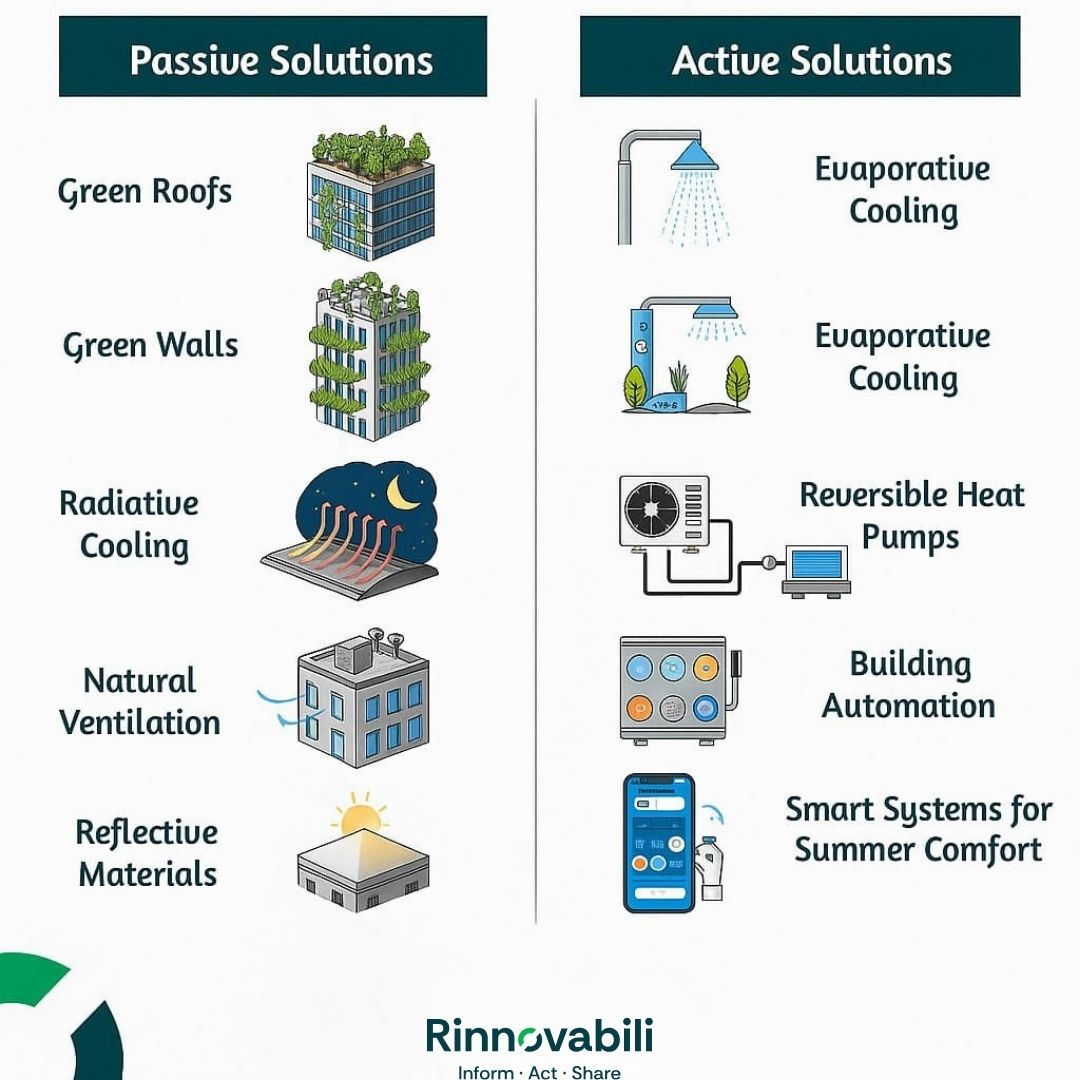
Among the strategies to counter this global challenge, passive urban cooling methods can deliver remarkable results. Without increasing energy costs or relying on artificial air conditioning, these natural approaches improve both building performance and citywide energy efficiency, ultimately reducing the overall thermal demand.
Green roofs, vegetated façades, natural ventilation, and radiative materials use biological and physical processes to mitigate the urban heat island effect.
Green and white roofs
The most immediate solution many think of is the green roof. Multiple studies show that vegetated roofs can lower indoor temperatures by up to 3 °C in summer, cutting heat flux by almost 50% through shading and plant evapotranspiration. In this regard, ENEA recently published national guidelines promoting urban greenery through the so-called “green envelope.”
According to the Italian Energy Agency, passive cooling using green roofs can reduce average city temperatures by 0.33 °C, with peaks of up to 1.17 °C during the hottest hours.
Vegetated façades
Beyond roofs, building façades also offer ideal surfaces to expand greenery and insulation. “Living walls” provide evaporative cooling and direct solar shading. In Turin, for instance, the installation of 6,000 square meters of vertical greenery reduced external air temperatures by 0.5 °C within so-called “urban canyons,” cutting heat flow into buildings by half.
Natural ventilation and building orientation
Beyond green roofs and façades, urban cooling also depends on a city’s ability to “breathe.” Natural ventilation, supported by bioclimatic design, building orientation, and the presence of green corridors, helps dissipate trapped daytime heat. Properly designed air pathways between buildings allow heat dispersion, easing nighttime cooling.
Passive radiative cooling
Complementing this natural airflow, passive radiative cooling exploits the temperature difference between Earth’s atmosphere and outer space to cool surfaces without energy consumption. New high-emissivity coatings and reflective paints enhance this natural effect, turning roofs and façades into radiative panels that can reduce temperatures by over one degree without switching on a single device.
High-efficiency active technologies
When passive cooling is not enough to ensure summer comfort, high-efficiency active technologies come into play. These combine renewable energy with advanced engineering to climatize buildings while minimizing environmental impact.
Evaporative cooling: the power of water
Evaporative cooling is one of the most effective active solutions. Used in cooling towers, it lowers air temperature through water evaporation, achieving efficiencies of 80–90%. A system developed by MIT combines evaporative and radiative cooling, reaching up to 300% higher efficiency compared to conventional passive systems. This approach is particularly suited for hot, dry climates, providing relief from extreme heat while keeping energy consumption low.
Reversible heat pumps and building automation
Reversible heat pumps remain among the most promising technologies, capable of cooling in summer and heating in winter with a single system. When paired with photovoltaic panels and energy storage, they can make buildings nearly energy-independent. Integrated with smart automation systems, such as temperature sensors and intelligent thermal regulation, they can cut summer energy consumption by up to 50%, reducing reliance on traditional air conditioners and contributing to more sustainable urban environments.
Recent European and national regulations, including Fit for 55 and the EPBD IV directive, are steering renovation efforts toward lower-consumption, higher-sustainability solutions.
The importance of urban planning
Urban greenery is no longer just about aesthetics. To truly address heat islands and climate challenges, cities must adopt large-scale, integrated urban planning. Initiatives such as urban forestry, ventilated corridors, and reflective materials have the potential to turn heat-absorbing cities into resilient ecosystems.
Urban forests are powerful climate adaptation tools. One example is the VRgreen project in Verona, promoted by the University of Verona and ARPAV, which focuses on urban reforestation to mitigate heat islands, improve air quality, and enhance synergies between natural and social capital. Similarly, the LIFE-ESCAPOS project in Florence Nova (2023–2027) integrates green infrastructure, environmental monitoring, reflective roofs, and urban resilience strategies.
High-albedo materials and permeable surfaces
Alongside vegetation and permeable surfaces, many cities are investing in high-albedo materials that reflect solar radiation instead of absorbing it. New-generation ultra-white paints can reflect up to 98% of sunlight, keeping surfaces cooler and reducing the need for air conditioning. Similarly, colored insulating coatings allow for energy savings without compromising on aesthetics.