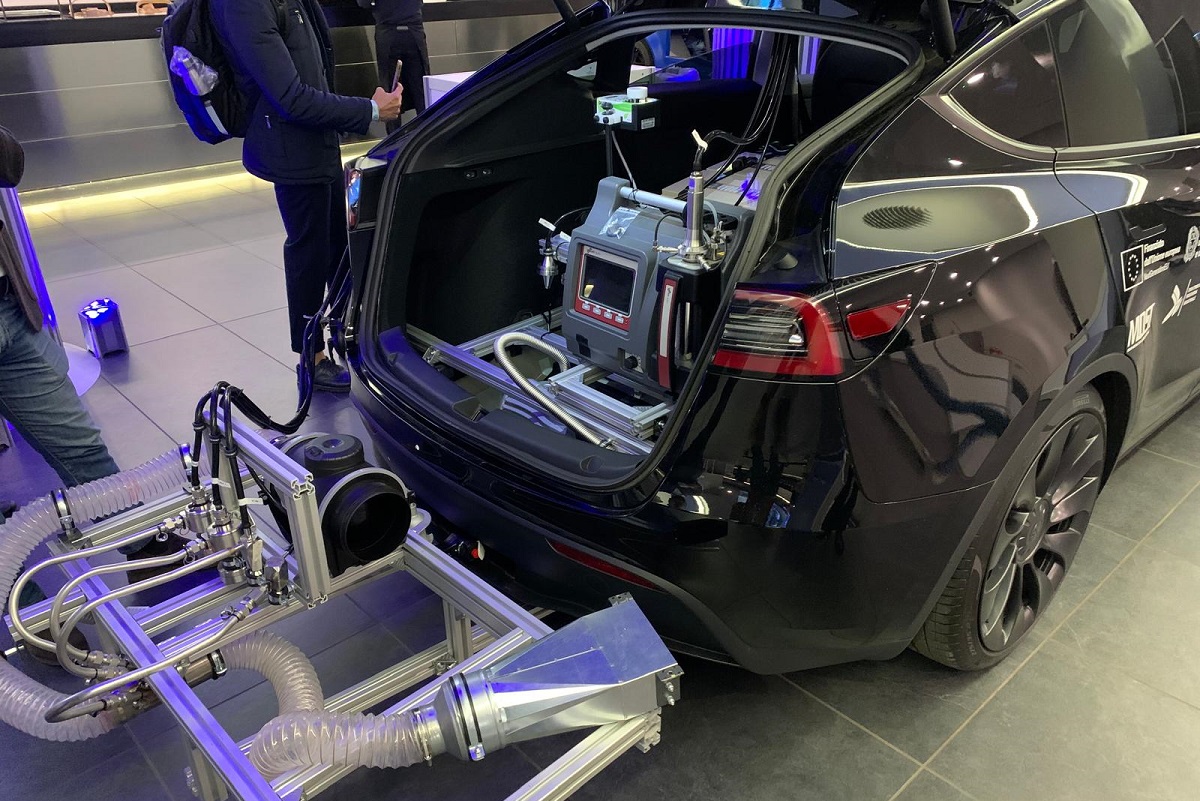
How particulate pollution is measured on electric vehicles
The new Euro 7 regulation calls for a reduction in particulate pollution linked to pollutants released by tires and brakes. This requirement has driven research that led to the development of a device capable of monitoring particulate emissions from an electric car’s tires and brakes, in this case a Tesla.
The system was showcased at the latest edition of MOST in Rome as part of the S.i.s.t.e.r. project developed by the University of Naples Federico II under the guidance of Andrea Genovese, professor of mechanical engineering, with the support of a team of young researchers.
A mobile laboratory designed to understand the physics of particulate pollution
The vehicle operates as a true mobile laboratory with a specific mission: to explore the underlying physics of the problem. The goal is not only academic research but also to refine the Euro 7 framework, which sets emission limits that remain vague due to limited scientific understanding of these specific pollutants.
“The vehicle has been fully outfitted without structural modifications, so it can be restored to factory conditions and maintain its original driving dynamics,” Genovese explains. He adds, “A dedicated air duct captures particulate matter from the front wheel, the rear wheel and the surrounding environment, separating it from brake dust. A mechanical separator directs the airflow into two distinct paths, distinguishing tire particles from those generated by braking. Our measurement system tells us how much of each pollutant is produced and links the data to driving styles, road types and temperatures.”

The onboard technology behind the measurement system
At the heart of the data acquisition system is an advanced Siemens platform known as SCADAS. This system synchronizes and records onboard signals, collecting data from around 50 channels simultaneously. Some analyses are performed in real time, while others require stopping the vehicle to examine samples in the lab.
“The primary objective of this project is to reduce particulate emissions from tires and brakes, which are estimated to account for about 30 percent of total particulate pollution in urban areas. But the value of the project extends beyond environmental protection and regulatory compliance,” Genovese continues. “From an industrial perspective, the vehicle is a key resource for tire and brake manufacturers. Access to real-world data and associated models shortens product development timelines and reduces costs by avoiding extensive outdoor testing.”
Particulate pollution, the start of full-scale testing
With the instrumentation phase completed, the project has built all the necessary infrastructure. Now, Genovese explains, “testing begins to develop strategies for reducing particulate emissions.” The testing program relies on a partnership that includes the University of Naples Federico II, industrial partner Pirelli, the Polytechnic University of Turin and the CNR Stems research institute.
Tests will be conducted both indoors, with the vehicle on rollers, and outdoors on test tracks. Activities will take place in northern and southern Italy to fully assess the impact of different climate conditions.