Electric vehicle pollution, emissions keep falling
An electric car has a lower environmental impact than a gasoline-powered vehicle. From manufacturing to end of life, total greenhouse gas emissions are lower. Beyond speculation, a new study from the University of Michigan reinforces what a growing body of evidence already shows.
Researchers evaluated multiple driver profiles, usage patterns and vehicle types. On average, a battery electric vehicle with a 480-mile range produces 31-36% fewer emissions than a plug-in hybrid. Compared with a hybrid electric vehicle, emissions are 63-65% lower, and 71-73% lower than an internal combustion engine vehicle.
The study also highlights a factor often overlooked in the U.S., vehicle size. Downsizing matters. A compact internal combustion vehicle emits 34% less than a gasoline pickup truck, a segment that dominates American roads but is far less common in Europe.
The analysis is among the most comprehensive to date. It provides per-mile emissions estimates, 1 mile equals 1.6 km, across 35 combinations of vehicle types and powertrains, including conventional gasoline pickups, hybrid SUVs and fully electric sedans.
“Vehicle electrification is a key strategy for climate action. Transportation accounts for 28% of greenhouse gas emissions. We need to reduce them to limit future climate impacts such as floods, wildfires and droughts, which are increasing in intensity and frequency,” said Greg Keoleian, senior author of the study and professor at the University of Michigan School for Environment and Sustainability.
A detailed U.S. case study on electric vehicle pollution
The research team also developed a free online calculator that allows drivers to estimate greenhouse gas emissions based on the vehicle they drive, how they drive and where they live. The tool is specific to the United States, as it factors in regional electricity grid data.
One example from the study shows how payload affects emissions. Transporting 1,100 kilograms in a gasoline pickup increases emissions by 13%, from 134 to 152 grams of CO2 equivalent per mile. Under heavier load conditions, emissions can rise by 22%, from 486 to 592 grams of CO2 equivalent per mile.
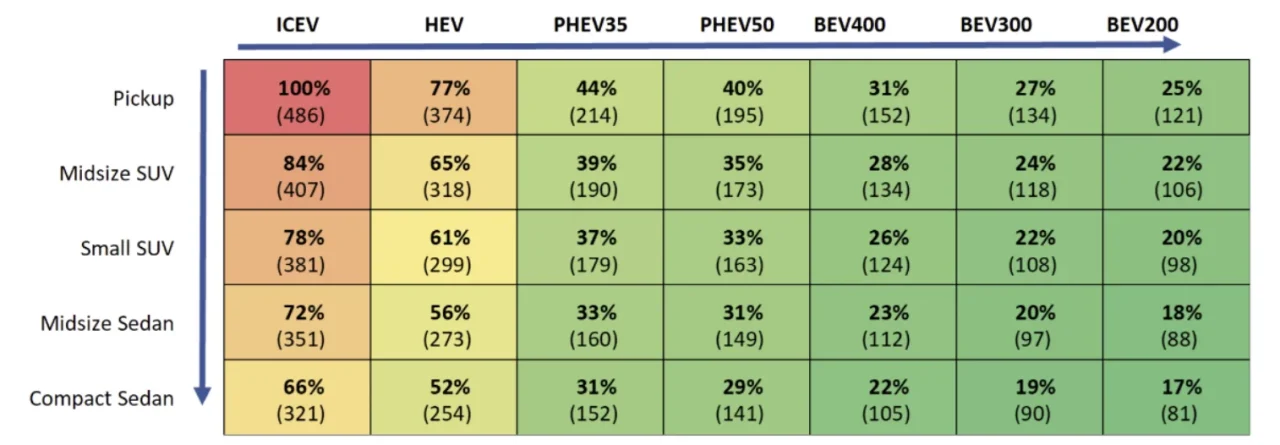
The comparison chart in the report contrasts the greenhouse gas emissions of different vehicle types against those of a gasoline pickup. Emissions are expressed in grams of CO2 equivalent per mile. Powertrain abbreviations include ICEV, internal combustion engine vehicle, HEV, hybrid electric vehicle, PHEV, plug-in hybrid electric vehicle, and BEV, battery electric vehicle. Numbers following the abbreviation indicate electric range, for example BEV400 refers to an electric vehicle with a 400-mile range.
Geography and grid mix matter
Location affects emissions in two key ways. First, all vehicles, especially BEVs and PHEVs, consume more energy in colder temperatures, reducing range and efficiency. Second, the carbon intensity of the electricity grid varies by region. Charging an electric vehicle in a county with a cleaner energy mix results in lower lifecycle emissions.
By integrating all these variables into a single framework, researchers were able to compare vehicles on a consistent basis. That enabled detailed contrasts, such as between a gasoline pickup in Perry County, Pennsylvania, and a compact electric sedan in San Juan County, New Mexico.
Electric pickup or gasoline pickup
The study found that battery electric vehicles have lower lifecycle emissions than any other vehicle type in every U.S. county analyzed. On average, internal combustion pickups were the highest emitters, at 486 grams of CO2 equivalent per mile. Switching to a hybrid pickup reduces emissions by 23%, while a fully electric pickup cuts them by 75%.
An additional finding concerns loaded vehicles. An electric pickup carrying 1,160 kg still emitted less than 30% of the CO2 of an unloaded gasoline pickup.
Compact electric sedans lead the rankings
Overall, compact electric sedans recorded the lowest emissions. At just 81 grams of CO2 equivalent per mile, they emit less than 20% of the per-mile emissions of a gasoline pickup. The lowest-emitting category was compact BEVs with shorter range, around 320 km.
The findings reinforce the conclusion that electric vehicle pollution, when assessed across the full lifecycle, remains significantly lower than that of gasoline-powered vehicles, even in regions where electricity generation still relies partly on fossil fuels.