Emissions since 1990 linked to $10 trillion in damage
U.S. greenhouse gas emissions since 1990 have caused more than $10 trillion in global economic damage, according to research published in Nature by scientists at Stanford’s Doerr School of Sustainability. The analysis connects emissions to observed changes in economic output across countries, assigning monetary values to both past and projected losses.
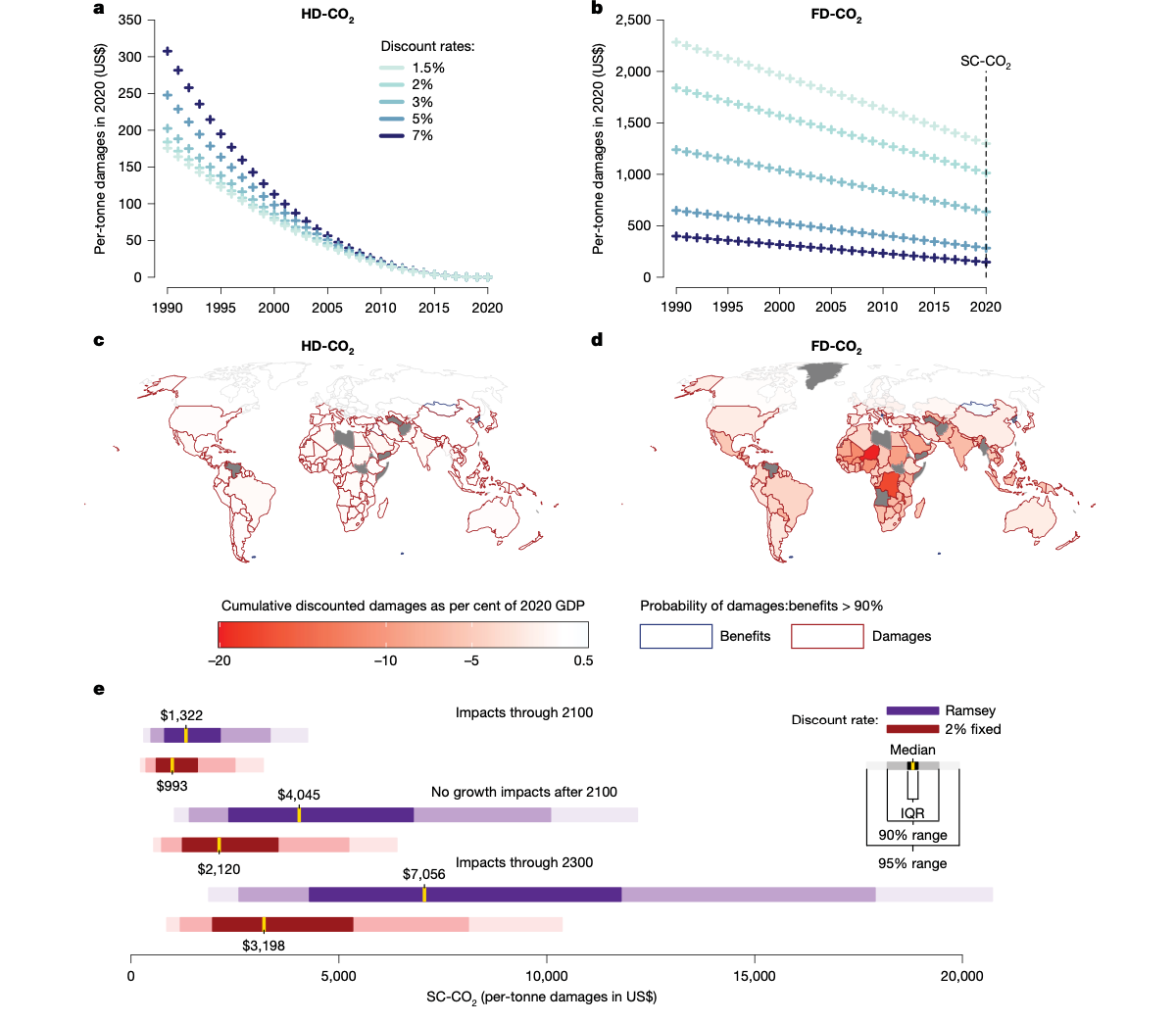
The estimates extend across decades. A single tonne of CO₂ emitted in 1990 caused about $180 in global damages by 2020, with a range of $40 to $530. That same tonne is projected to generate an additional $1,840 in damages through 2100, with estimates between $500 and $5,700. Earlier emissions accumulate more impact because they remain in the atmosphere longer and affect economic activity over a greater number of years.
Future damages from emissions exceed past losses
Using a 2 percent discount rate, the study finds that damages expected between 2021 and 2100 are roughly ten times larger than those already observed for emissions released in 1990. At higher discount rates, the gap narrows but does not disappear. At 5 percent, future damages remain about three times larger than historical damages. Earlier emissions continue to generate measurable effects over extended time horizons.
The study treats emissions as producing a stream of damages rather than a single event. Carbon dioxide persists in the atmosphere for decades to centuries, and the resulting temperature changes influence economic growth rates. A shift in growth produces cumulative effects, widening the difference between observed output and a lower-emissions baseline over time.
The long-term cost of emissions in practical terms
Illustrative estimates in the paper translate those effects into more familiar terms. One additional long-haul flight per year between 2010 and 2020 leads to about $165 in damages through 2020. Over a longer period, the same activity produces roughly $25,000 in damages between 2021 and 2100, with a range of $6,000 to $77,000. Reducing driving by 10 percent, switching to a vegetarian diet, or installing a heat pump each corresponds to about $6,000 in avoided damages through 2100 when maintained over a decade.
Global and corporate impacts of emissions
Country-level impacts show both concentration and dispersion. U.S. emissions between 1990 and 2020 account for approximately $10.2 trillion in global damages over that period. Around 30 percent, or $2.97 trillion, occurs within the United States. India accounts for roughly $500 billion in damages linked to U.S. emissions, with a range of $180 billion to $1.3 trillion. Brazil accounts for about $330 billion, with estimates between $110 billion and $820 billion. China, the European Union, and other large economies also absorb substantial shares.
The study also reports a social cost of carbon of $1,013 per tonne under a 2 percent discount rate, assuming impacts through 2100. Extending impacts through 2300 or adjusting growth assumptions increases estimates to above $2,000 and, in some scenarios, beyond $7,000 per tonne.
Company-level estimates scale those impacts further. Emissions associated with Saudi Aramco between 1988 and 2015 caused about $3 trillion in damages through 2020. Projected damages from those same emissions reach approximately $64 trillion by 2100. ExxonMobil’s emissions over the same period account for about $1.6 trillion in damages through 2020, with an additional $29 trillion expected through the end of the century. Limiting the calculation to direct production emissions reduces totals by roughly an order of magnitude.
Limits of emissions mitigation over time
The study also evaluates carbon dioxide removal. Immediate removal of emissions prevents most associated damages. A delay of 25 years reduces avoided damages by about half, as losses accumulate before removal occurs. Timing changes the share of future impacts that can still be limited.The results describe an economic process that continues to unfold. Damages linked to emissions released decades ago are still accumulating, and under most modeled scenarios, a larger share of total losses remains in the future.