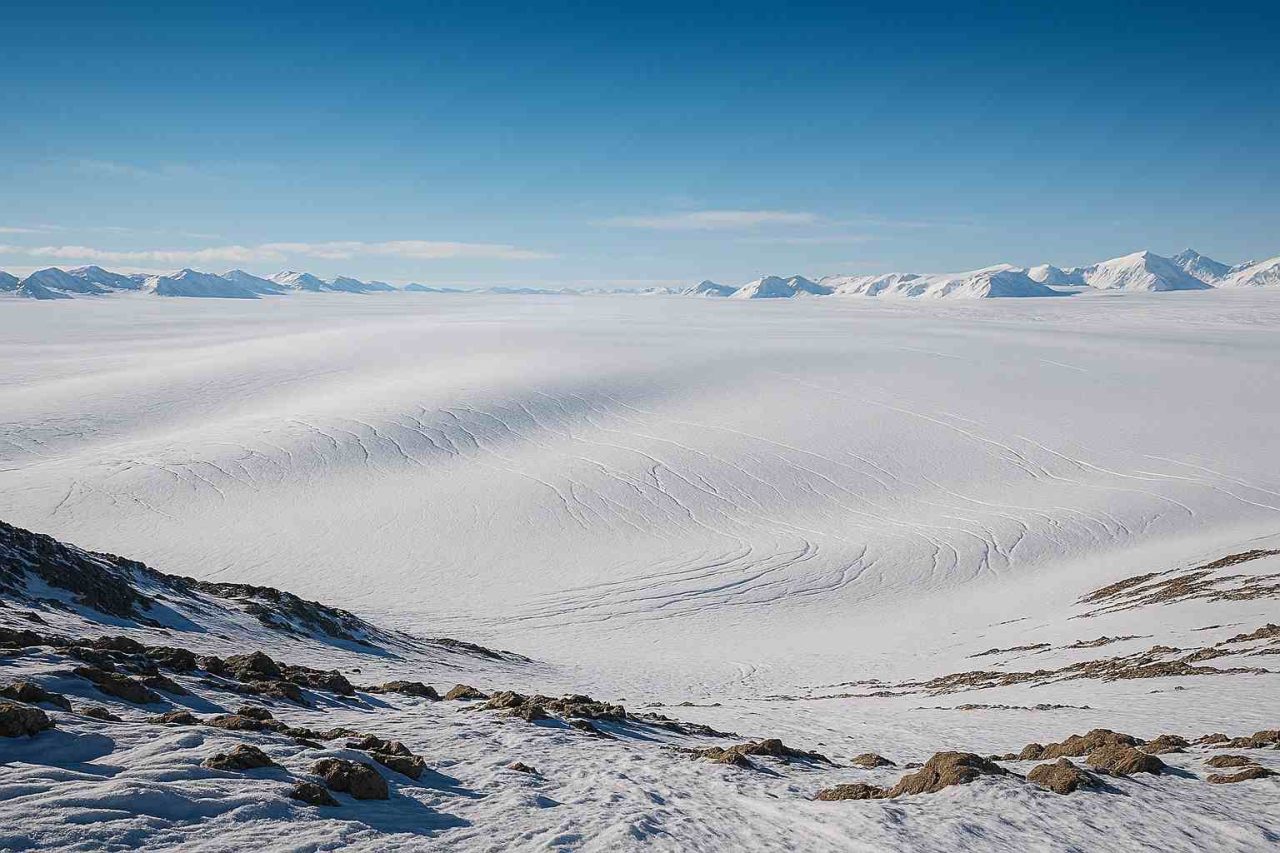
Antarctic ice melt linked to ancient self-reinforcing feedback mechanisms
The melting of the East Antarctic ice sheet nearly 9,000 years ago was caused by a self-reinforcing mechanism triggered by ice-shelf melting and ocean circulation. A new study has clarified the process behind the collapse of the East Antarctic ice sheet. Understanding how large ice sheets have responded to past climate warming could help refine future projections, especially in the context of today’s global temperature rise.
Understanding the Antarctic ice melt
The inflow of circumpolar deep water near Antarctica’s continental shelves accelerates ice mass loss. Yet, the mechanisms driving this warm-water intrusion and its impact on the ice sheet had remained unclear. The new research reveals that past intrusions of warm deep water along East Antarctica’s coast caused ice shelves to collapse. In turn, that melting accelerated inland ice loss.
This discovery shows that Antarctic ice retreat is not merely a local event. Oceanic connections can amplify ice loss, as meltwater from one region triggers further melting in others, a phenomenon scientists call cascading positive feedback. Understanding this process helps explain the present-day instability of Antarctic ice sheets.
The findings were published in Nature Geoscience and led by Professor Yusuke Suganuma from Japan’s National Institute of Polar Research (NIPR) and the Graduate University for Advanced Studies (SOKENDAI).
The mechanism behind the East Antarctic ice melt
The East Antarctic ice sheet, which holds about half of the world’s freshwater reserves, is losing mass in some coastal areas. To understand how ancient ice responded to past climate warming, researchers analyzed marine sediments collected from Lützow-Holm Bay, along the Sôya Coast, between 1980 and 2023, including recent cores retrieved by the icebreaker Shirase.
The study found that around 9,000 years ago, an increase in warm circumpolar deep water (CDW) inside the bay led to the collapse of floating ice shelves. Once these shelves disintegrated, they lost their buttressing effect, allowing the interior ice to flow more rapidly toward the ocean.
The self-reinforcing feedback
Using a hierarchical modeling approach that combines high-resolution climate and ocean simulations, the team found that freshwater discharge from nearby Antarctic sectors likely boosted regional inflows into Lützow-Holm Bay between 10,000 and 9,000 years ago. Researchers describe this as a self-reinforcing feedback: meltwater enhanced ocean stratification and allowed warm CDW to intrude beneath adjacent ice shelves.
This process not only contributed to sea-level rise but also triggered further ice-shelf instability, accelerating the dynamic outflow of interior ice and amplifying the melting cycle.
A warning from the past
The study provides some of the clearest evidence yet that the Antarctic ice sheet can undergo widespread, self-reinforcing melting in response to natural climate warming. Although the event occurred during the early Holocene, a period warmer than the last glacial age, the same mechanisms may apply to today’s anthropogenic climate change.
Recent observations show that parts of the West Antarctic ice sheet, including the Thwaites and Pine Island glaciers, are already retreating rapidly due to intruding warm deep water. If similar cascading feedbacks are now in motion, regional melting could spread and accelerate total ice-mass loss, contributing further to global sea-level rise.
Read the full study in Nature Geoscience.