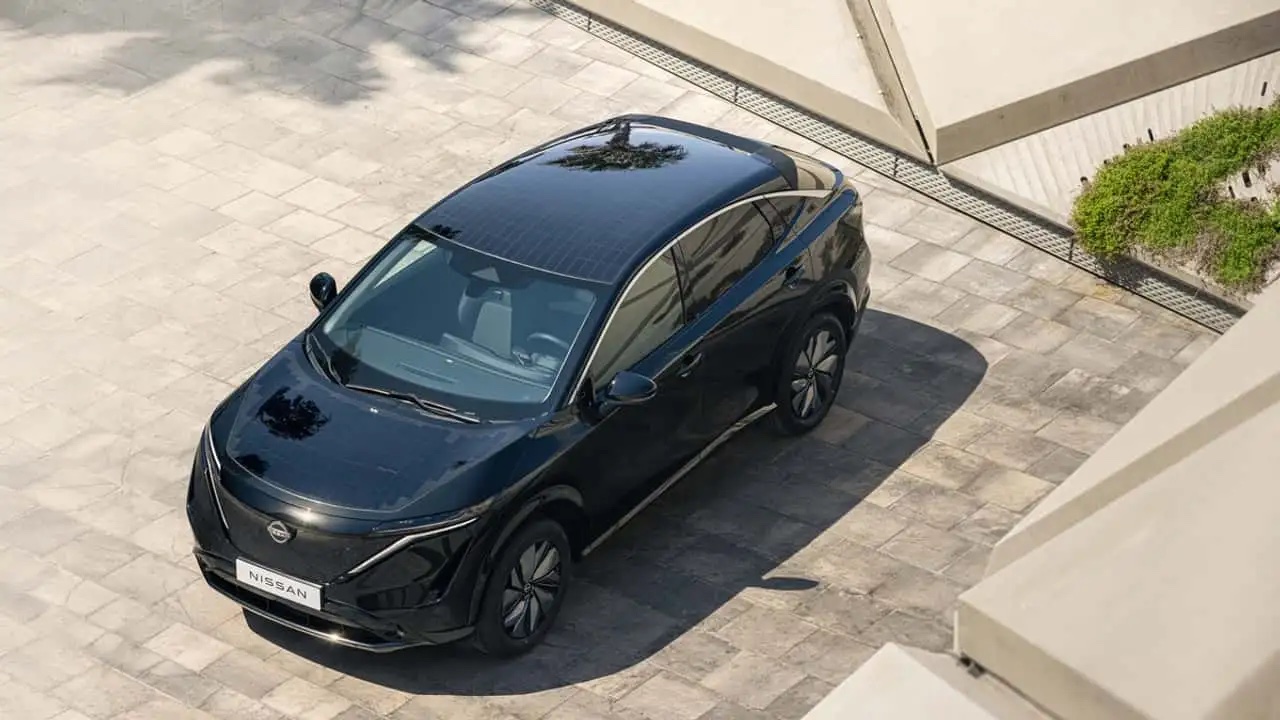
Solar panels on the Nissan Ariya to extend daily range
This is not the first attempt, but Nissan’s concept may actually work. The Japanese automaker has equipped the all-electric Nissan Ariya with solar panels installed on the roof, hood, and rear hatch, feeding energy directly into the battery. The result is a daily range boost of up to 23 km, depending on how much sunlight the vehicle captures, and a lower need for plug-in charging.
The photovoltaic panels cover a total surface of 3.8 square meters, enough to harvest sunlight and convert it into electricity that reduces charging frequency. In real-world tests conducted by Nissan across several cities, including London, Barcelona, and Dubai, the system generated an average of 18 km of additional range per day. Results varied widely, from about 10 km in cloudy London to roughly 21 km under Dubai’s desert sun.
How much range does solar really add?
The project was developed at Nissan’s research center in Dubai in collaboration with the Nissan Powertrain Planning Team in Barcelona. The solar cells were supplied by Lightyear, a Dutch company that has already experimented with integrated photovoltaic panels on passenger vehicles.
According to Nissan, the technology could cut the number of charging cycles by 35-65%. To put that into context, during a two-hour trip covering more than 80 km, the panels generated about 0.5 kWh of solar energy, equivalent to roughly 3 km of extra range. That may sound modest, but cars spend most of their time parked, often outdoors and during daylight hours. From that perspective, the concept starts to make sense, provided it does not translate into a significant increase in vehicle cost if it reaches the market.
Fewer charges, more autonomy for Nissan Ariya
“Nissan believes that innovation and sustainability must go hand in hand. The solar-powered Ariya concept is not just a technical milestone, it represents our vision for leading the next phase of electric mobility, offering greater freedom and less dependence on charging,” said Shunsuke Shigemoto, vice president ePowertrain and ICE Powertrain, Technology Research & Advanced Engineering, and chief powertrain engineer at Nissan AMIEO.
If the project were to move into mass production, it could make a meaningful contribution to the energy transition. Even an extra 20 km of daily range, free and with zero emissions, would cover the typical daily driving needs of many users.
There is more. Tests show that thanks to the photovoltaic panels, annual charging sessions for drivers covering at least 6,000 km could drop from 23 to just 8. Fifteen fewer charges a year is a tangible benefit, both for drivers and for the broader energy system.