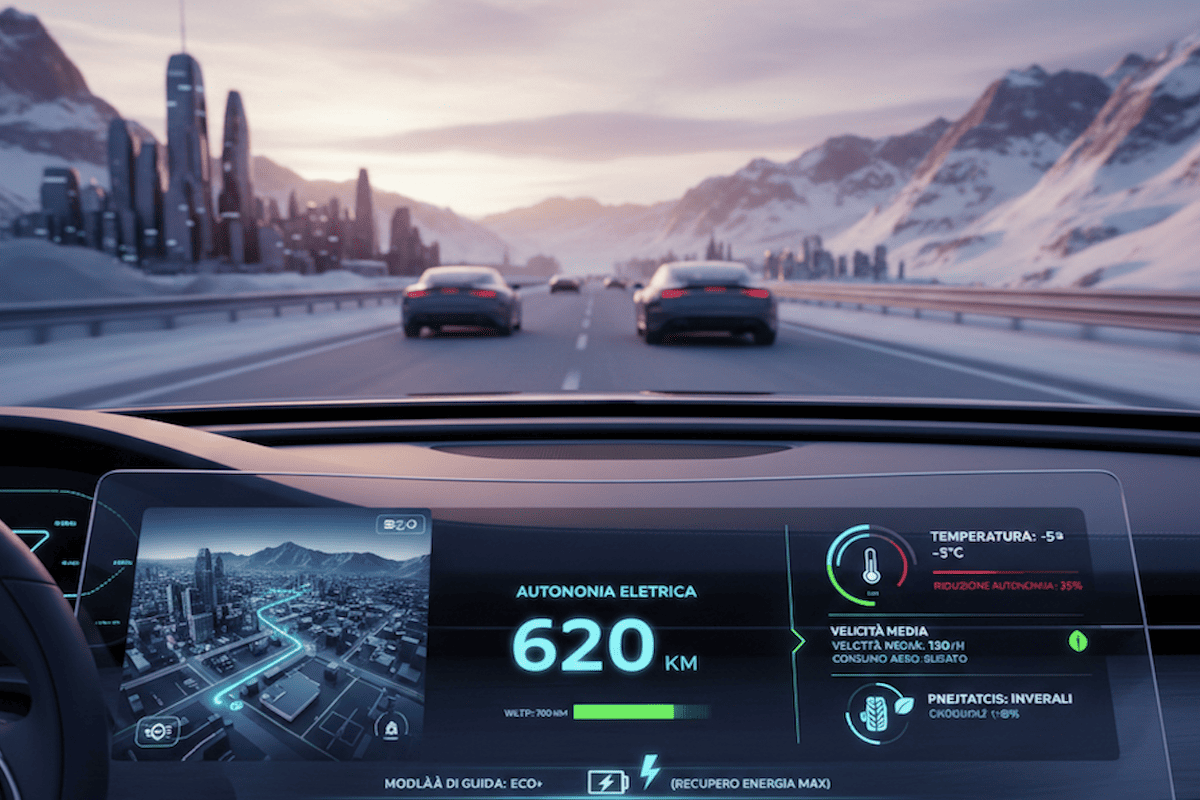
Electric car range under extreme winter conditions
Sub-zero temperatures, icy asphalt, and snow-covered roads represent some of the most challenging conditions for any vehicle. Electric cars are no exception. When batteries are exposed to prolonged cold, their usable capacity inevitably declines, leading to a tangible loss in real-world range.
This effect emerged clearly from the El Prix Winter Test, a real-world trial conducted in Norway with a starting point in Oslo. Organized by the Norwegian Automobile Federation, the test offers a concrete snapshot of how battery electric vehicles behave when pushed to their limits in one of Europe’s harshest winter environments.
How the Norwegian winter test was conducted
The Norwegian test involved 25 battery electric vehicles driven over the course of a single day in extremely severe conditions. Along the route, ambient temperatures dropped to as low as −31 °C, with snow-covered roads further increasing energy demand.
In addition to the driving phase, charging sessions were also carried out to measure power curves and the time required to recharge batteries from 10% to 80% state of charge. In this edition, temperatures recorded during El Prix reached new historic lows, fluctuating between −31 °C and −10 °C.
Real-world results vs. declared range
All 25 electric cars began the test with batteries charged to 100% and followed a mixed route combining urban driving, highways, and rural roads. Each vehicle continued until it could no longer sustain the speed requested via the accelerator pedal.
The outcome was uniform: none of the tested BEVs achieved the electric car range declared by manufacturers under WLTP homologation.
As expected, freezing temperatures significantly reduced battery performance. The model that covered the longest absolute distance was the Lucid Air Grand Touring, which reached 520 km. However, this represented a 46% reduction compared with its declared WLTP range of 960 km. As a result, it ranked first for distance driven, but last in terms of deviation from official figures.
Winners and underperformers in cold weather
The best performer in relative terms was the Hyundai Inster. Although it covered only 256 km, compared with a declared 360 km, its deviation from the official figure was far smaller than that recorded by longer-range models.
At the bottom of the ranking were vehicles combining high energy consumption with wide gaps versus WLTP data. Among the weakest performers were the Mercedes-Benz CLA, which achieved 421 km out of a declared 709 km, and the Volvo EX90, which reached 339 km compared with 611 km declared.
Electric car range: WLTP vs real-world winter test
| model | WLTP range (km) | real-world range (km) | deviation |
|---|---|---|---|
| Lucid Air Grand Touring | 960 | 520 | −46% |
| Mercedes-Benz CLA | 709 | 421 | −41% |
| Audi A6 Sportback e-tron | 653 | 402 | −38% |
| BMW iX | 641 | 388 | −39% |
| Volvo ES90 | 624 | 373 | −40% |
| Volvo EX90 | 611 | 339 | −45% |
| Tesla Model Y | 600 | 359 | −40% |
| Hyundai Ioniq 9 | 600 | 370 | −38% |
| Kia EV4 | 594 | 390 | −34% |
| Ford Capri | 560 | 339 | −39% |
| Xpeng X9 | 560 | 361 | −36% |
| Mazda 6e | 552 | 348 | −37% |
| Zeekr 7X | 541 | 338 | −38% |
| Smart #5 | 540 | 342 | −37% |
| Skoda Elroq | 524 | 309 | −41% |
| MG IM6 | 505 | 352 | −30% |
| MG 6S | 485 | 345 | −29% |
| Opel Grandland | 484 | 262 | −46% |
| Volkswagen ID. Buzz | 449 | 227 | −38% |
| Changan Deepal S05 | 445 | 293 | −34% |
| Voyah Courage | 440 | 300 | −32% |
| Suzuki eVitara | 395 | 224 | −43% |
| KGM Musso | 379 | 263 | −31% |