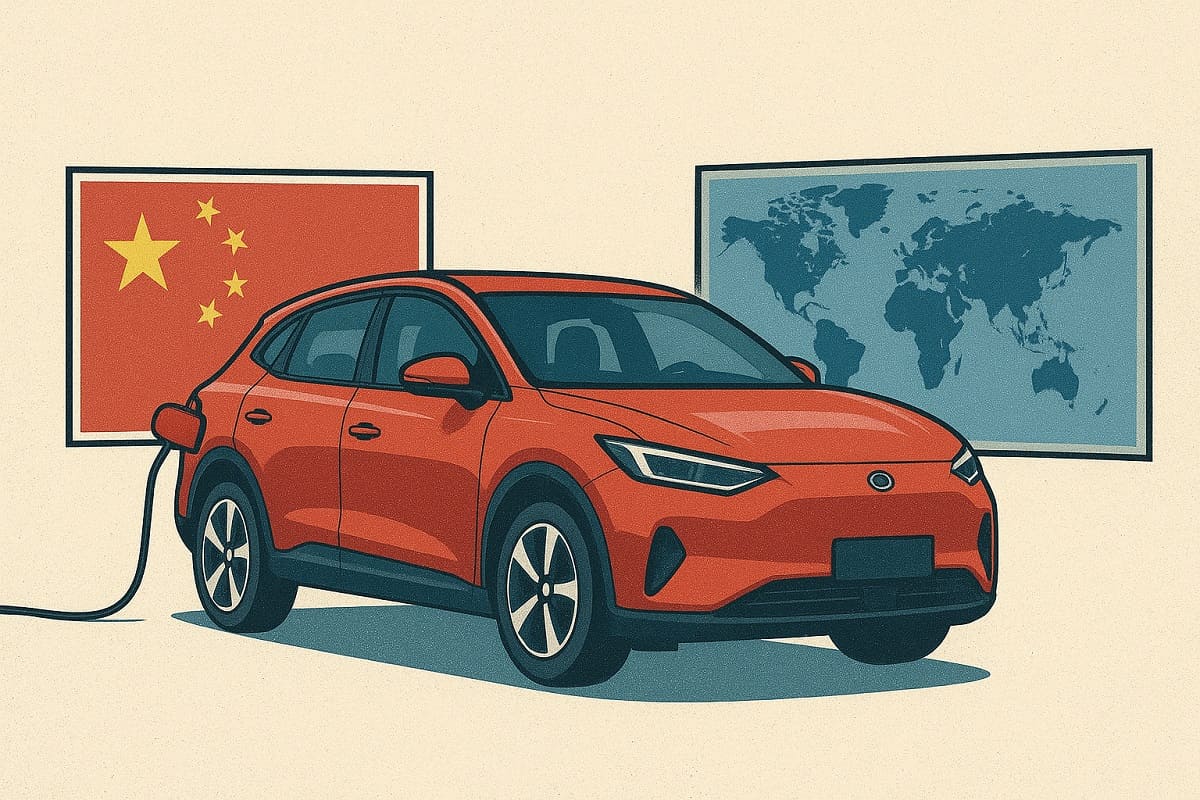
Stricter rules for Chinese electric car exports
Too many made-in-China vehicles are flooding global markets. This time, the alarm does not come from competitors in the automotive industry but from an official branch of the Chinese government. Starting January 1, 2026, all Chinese manufacturers and exporters of electric cars will need an official license to ship their vehicles abroad. The announcement came from China’s ministry of commerce.
The goal is clear, to regulate and control massive zero-emission vehicle exports. China has already become the world’s top exporter of battery electric vehicles, surpassing Japan. Meanwhile, the European Union is racing to catch up by supporting domestic production of affordable small evs priced around 15,000 euros.
What the new regulation means for exporters
Industry analysts estimate that within five years China could export up to 10 million electric cars annually, expanding its footprint not only in Europe and the United States but also in emerging markets such as the Middle East, South America, and Africa. According to Spanish outlet El Periódico de la Energía, one driver behind the new mandate is the presence of irregular exports, with new cars sold as “used” through unauthorized export channels.
This practice has created problems for international buyers, who often receive vehicles with outdated software and limited after-sales support. Coupled with an aggressive pricing strategy, these issues have undermined both the image of Chinese automakers and the profitability of the sector.
The export license framework
Under the new framework, only accredited manufacturers and dealers will be allowed to apply for licenses. The move aims to prevent foreign markets from being flooded with low-cost models that distort competition. The measure also extends regulatory consistency to the broader Chinese auto industry, mirroring restrictions long applied to combustion engine and hybrid car exports.
The rules will also affect foreign giants manufacturing in China, such as Tesla, Volkswagen, and BMW, which rely on local plants to supply global markets thanks to competitive costs and integrated supply chains.
Restoring the image of Chinese automakers
China’s aggressive ev export push, visible at major industry events such as the IAA Mobility show in Munich, is now being standardized through the licensing requirement. The measure is designed to improve after-sales service, long seen as the weak point of Chinese hybrids and battery electric vehicles, and to ensure higher overall quality.
At the same time, Beijing has tightened controls on the export of advanced battery technologies, safeguarding its dominant position in a sector that remains critical for the future of electric mobility.