
CES 2026 turns cars into consumer electronics
The car as a consumer electronics product. At CES 2026 in Las Vegas, automotive technology, and increasingly the cars themselves, rank among the most anticipated highlights of this year’s edition. Onboard software, electronics replacing traditional mechanics, and artificial intelligence dominate the narrative, positioning vehicles as software-defined platforms at the heart of the consumer tech ecosystem.
The Hyundai robot and human-centered ai
At CES 2026, Hyundai Motor Group unveiled an artificial intelligence-driven robotics strategy branded “Partnering Human Progress,” marking a shift from hardware-centric platforms to adaptive, collaborative robots designed around human needs. The focus is on Physical AI applied to industry, logistics, and mobility, developed through tight integration of manufacturing, real-world data, and software.
In collaboration with Boston Dynamics, the group showcased the evolution of operational robots such as Spot and Stretch, alongside the new humanoid Atlas. Designed to work safely alongside people in industrial environments, Atlas is expected to enter mass production within the next decade.
Hyundai’s ai robotics roadmap rests on three pillars:
- Collaboration between humans and robots: robots designed to assist and work alongside people, starting from manufacturing environments, by performing dangerous and repetitive tasks.
- Collaboration between the Group’s value network and Boston Dynamics: combining Boston Dynamics’ expertise in AI robotics with Hyundai Motor Group’s global scale and manufacturing capabilities to create safe training environments and an end-to-end (E2E) value chain in AI robotics.
- Collaboration with leading players in artificial intelligence: partnerships with global AI pioneers to open new chapters in AI-based robotics innovation and advance the “Progress for Humanity” vision.
Hyundai also announced dedicated investments and infrastructure, including training centers and robotic factories, technology partnerships with AI leaders such as NVIDIA and Google DeepMind, and a Robot-as-a-Service model to accelerate large-scale adoption, outlining a roadmap aimed at making human-robot collaboration a concrete and widespread reality.

CES 2026 and the rise of Physical AI
But what exactly is Physical AI? The term refers to artificial intelligence technologies embedded in real-world physical systems such as robots, autonomous vehicles, industrial machines, and smart factories. Unlike purely digital AI, Physical AI perceives the real world through sensors, makes autonomous decisions, and acts through motors, arms, wheels, or other actuators. By combining software and hardware, these systems operate in dynamic environments and learn from field data. Typical examples include collaborative factory robots, autonomous driving systems, and logistics robots that adapt in real time to spaces and objects.
BMW iX3 and the intelligent personal assistant
At CES 2026, BMW Group highlighted the evolution of the software-defined vehicle with the debut of a new BMW Intelligent Personal Assistant, powered by the Amazon Alexa+ architecture, on the BMW iX3. Enabled by a generative large language model, the assistant supports natural, continuous dialogue, handles multiple requests in a single sentence, and integrates vehicle functions with navigation and external content such as music, news, and cultural information.
For the first time, users will also be able to ask multiple questions in a single sentence, covering both vehicle features and general knowledge topics. The use of predefined voice commands is no longer necessary, with the BMW Intelligent Personal Assistant, multiple requests and questions can be linked together as in a normal human conversation, and follow-up questions can be asked. This innovation, which will initially be available in Germany and the United States from the second half of 2026, represents a key step in BMW’s strategy to extend conversational AI across its entire lineup, transforming the car into a true digital companion connected to the customer ecosystem.

Mercedes unveils the electric GLC
CES 2026 will also host the official US debut of the electric Mercedes-Benz GLC. The SUV delivers up to 483 horsepower with a dual-motor setup, offers more than 700 km of WLTP range, and features an 800-volt architecture for ultra-fast charging. Inside, the MBUX Hyperscreen anchors a strategy focused on digital services, over-the-air updates, and subscription-based features, while next-generation driver assistance technologies are developed in partnership with NVIDIA.
The launch also introduces MB.DRIVE ASSIST PRO on the Mercedes-Benz GLC 400 4MATIC. Already active in China, the system will reach the US market at a cost of 3,950 dollars for three years, enabling autonomous driving from parking to destination, managing intersections, turns, and traffic lights.
From robot vacuums to supercars at CES 2026
Dreame, globally known for robot vacuum cleaners and home cleaning devices, officially entered the automotive sector at CES 2026. Following Xiaomi’s path, Dreame launched two new brands, Nebula Next and Kosmera, targeting the high-end segment.
The model closest to production is the Nebula Next 01 Concept, a supercar with aggressive lines, large front air intakes, a pronounced splitter, clearly visible rear spoiler and diffuser, as well as six-spoke wheels that showcase a sport braking system with yellow calipers. Finished in a green livery with numerous carbon fiber elements, the vehicle promises extreme performance, around 1,900 horsepower delivered by four electric motors, one per wheel, enabling acceleration from 0 to 100 km/h in just 1.8 seconds.
Honda and Sony introduce Afeela
Another electronics heavyweight, Sony, enters the scene alongside Honda Mobility, which returns to the spotlight at CES by presenting Afeela 1, the pre-production version of its next-generation electric vehicle. Afeela 1 is conceived as a technology platform on four wheels, integrating 45 sensors including cameras, radar, and lidar, and is built on the Qualcomm Snapdragon Digital Chassis, with computing power in the range of hundreds of TOPS, designed to support advanced driver assistance systems and an enhanced entertainment ecosystem.
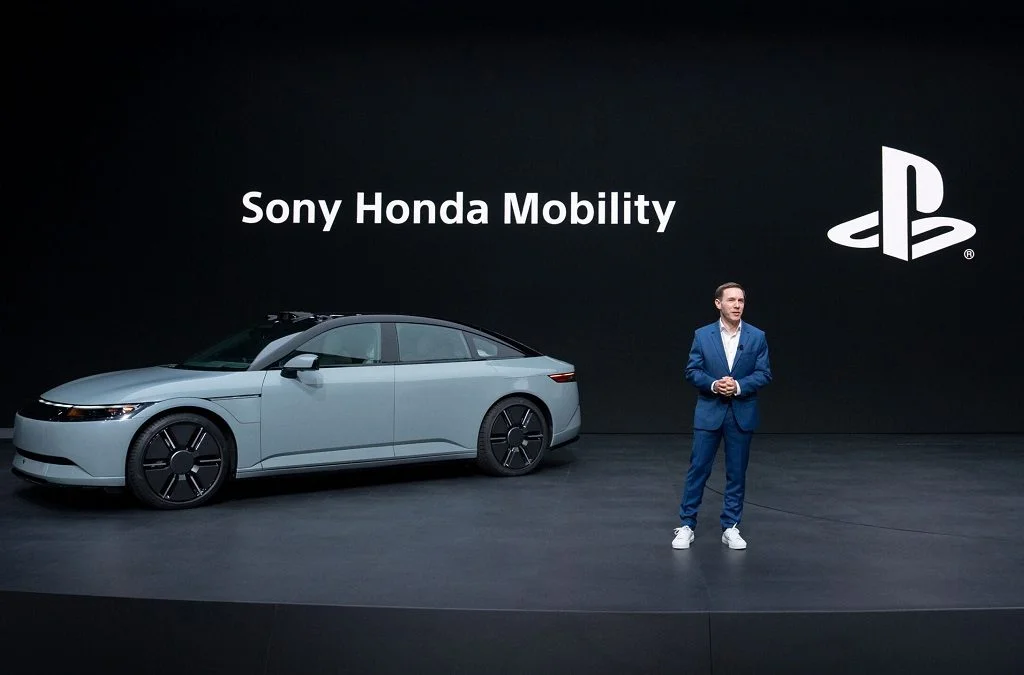
Sony plays a central role in shaping the digital experience, integrating Unreal Engine 5 for real-time graphics and immersive environments. The result is a cockpit inspired by video games and cinema, transforming the cabin into an extension of Sony’s entertainment universe. Strategically, Afeela is positioned as a “device-car,” a hybrid between a console, a personal cinema, and a premium vehicle, launching with Level 2 assistance and aiming for Level 3 in the future.