How the BMW iX3 strengthens sustainability from the first year
The new BMW iX3 showcased at the latest IAA in Munich advances the company’s long term plan to make electric mobility genuinely sustainable. The brand is adopting a comprehensive strategy that spans every phase of the vehicle’s life cycle, from sourcing materials to manufacturing and customer use. The goal is to reduce overall environmental impact and support the company’s CO2 objectives for 2030 and 2050.
A CO2 advantage starting in the first year
Thanks to extensive decarbonization measures, the BMW iX3 50 xDrive outperforms its internal combustion equivalent after 17,500 kilometers, roughly one year of driving, when charged exclusively with renewable electricity. When charged with the European grid mix, it surpasses a combustion model after about 21,500 kilometers WLTP combined.
BMW iX3 advances decarbonization across the supply chain
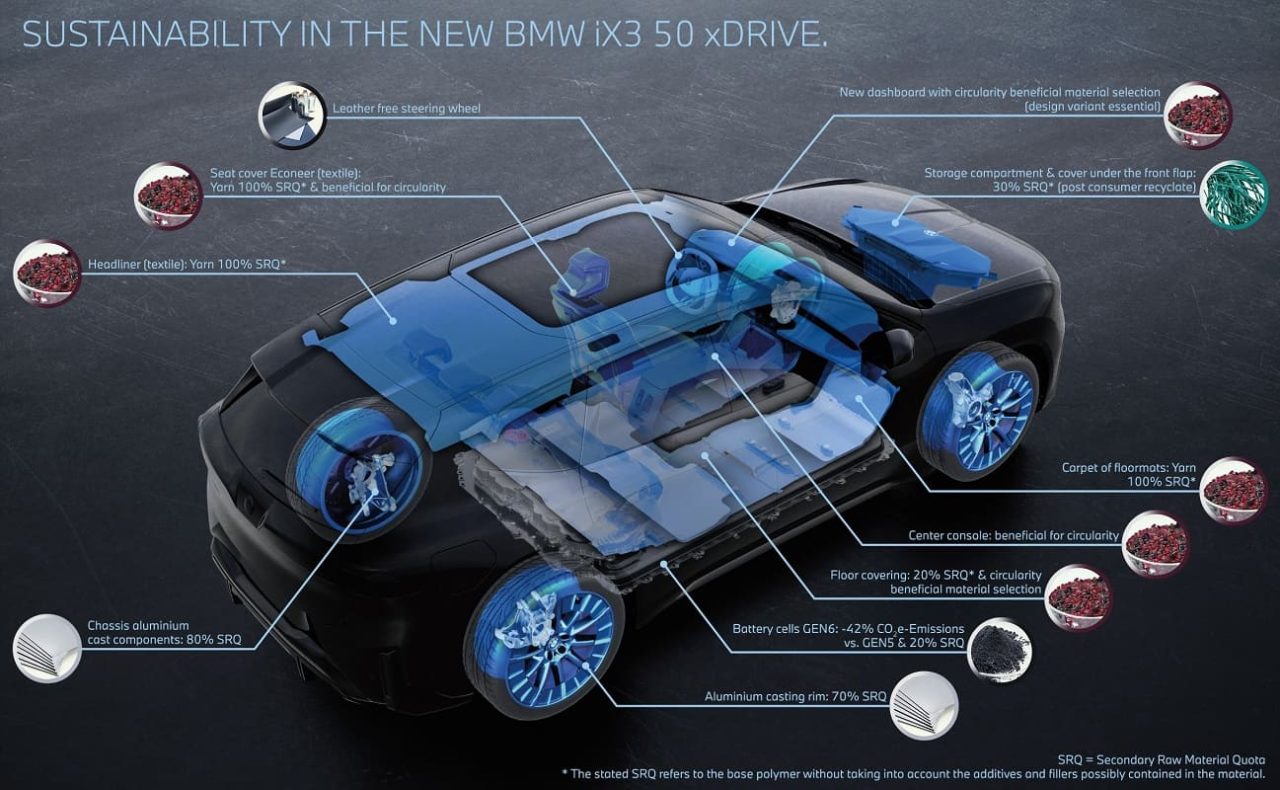
The BMW iX3 reduces emissions through secondary materials, renewable energy, and process innovations. Gen6 battery cells contain 50 percent secondary materials, including cobalt, lithium, and nickel, and per watt hour emissions have been cut by 42 percent compared to Gen5 cells.
Other components follow the same approach. Thirty percent of the plastics in the engine bay and storage compartments come from recycled fishing nets and ropes. Secondary aluminum accounts for 80 percent of wheel carriers and bearings, and 70 percent of cast aluminum wheels.
Design for circularity, materials and recyclability
The design for circularity framework guides the use of secondary materials, strategic component selection, and easier disassembly. About one third of all materials in the BMW iX3 50 xDrive come from recycled sources.
One example is the Econeer seat upholstery, made entirely from recycled PET, which improves recyclability and reduces the use of complex materials. The center console, dashboard, and interior trims are developed with the same criteria.
With these measures, the new BMW iX3 reduces energy consumption by 20 percent compared to the previous model, supported by optimized aerodynamics, lower rolling resistance, and more efficient onboard energy management.
Sustainable production at the Debrecen plant
The BMW iX3 is produced at the BMW iFactory in Debrecen, Hungary, the Group’s first plant to operate without fossil fuels. All energy comes from renewable electricity, with up to 25 percent of demand supplied by on site photovoltaic systems. Excess solar energy is stored and used to heat body shop ovens, further reducing emissions. Producing one BMW iX3 generates only 0.1 tons of CO2, about two thirds less than other manufacturing sites. BMW aims for net zero by 2050 and plans to reduce CO2 emissions by at least 40 million tons by 2030 compared to 2019.