Trump polysilicon tariffs target Chinese competition
President Donald Trump is imposing new trade barriers targeting China’s solar and semiconductor industries. The White House has introduced a series of minimum import prices alongside a 15% tariff on products made from polysilicon, a critical raw material whose global supply chain is heavily concentrated in China. The measures are designed to support and protect U.S. semiconductor and solar manufacturing from Chinese competition.
A new front in the U.S.-China trade war
The measures open a new front in the U.S.-China trade war. By establishing minimum import prices for polysilicon and products made from it, the Trump administration will effectively prevent goods priced below the established thresholds from entering the U.S. market. The policy could allow domestic manufacturers to sell their products at more profitable prices.
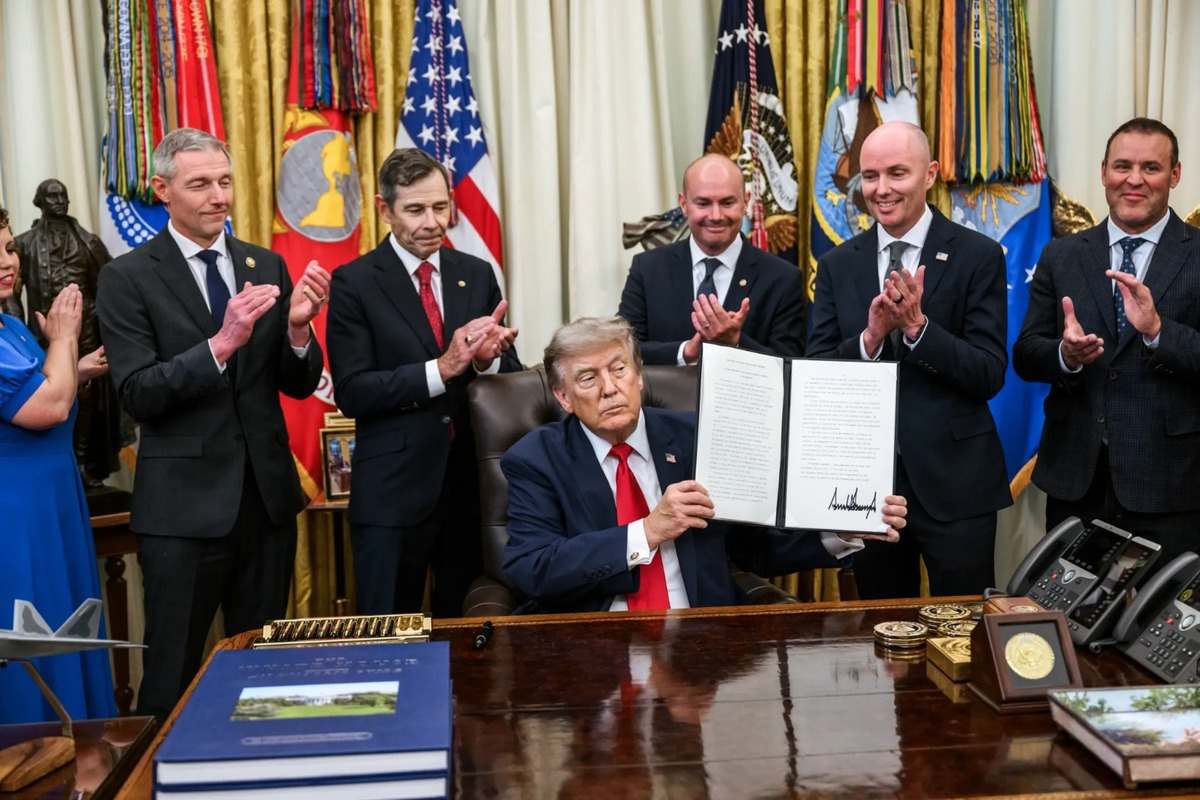
Trump’s executive order is intended to strengthen domestic supply chains for semiconductors and solar equipment, while challenging China in the race for artificial intelligence and energy dominance.
The White House has established minimum import prices of $21 per kilogram for polysilicon, $100 per kilogram for polysilicon ingots and wafers, $0.22 per watt for solar cells and $0.38 per watt for solar modules, or panels.
The tariffs will take effect on Dec. 4, and some observers have warned that the delayed implementation could trigger a surge in imports over the coming months.
Companies purchasing solar panels argue that the delay is necessary to adjust supply contracts to higher prices. But the four-month window could also encourage suppliers to accelerate shipments to the U.S., building inventories before the new costs take effect. Washington has said it will monitor potential attempts to circumvent the measures.
Trump has also directed Commerce Secretary Howard Lutnick to establish an incentive program for companies seeking to build or expand U.S. factories producing polysilicon and related products.
The administration considers greater domestic production a national security priority, since polysilicon is also a critical input for semiconductors used across electronic devices and defense technologies, including control systems for missiles and drones.
U.S. solar stocks rise after Trump polysilicon tariffs
U.S. solar stocks posted significant gains in premarket trading on Friday, Aug. 7, following the announcement.
Shares of First Solar rose more than 7% before the market opened, while SolarEdge Technologies gained about 1%. The Invesco Solar ETF climbed 4%.
U.S. manufacturers welcome the new trade measures
For the past decade, U.S. manufacturers have accused Chinese competitors of selling products overseas below domestic market prices, benefiting from unfair government subsidies and shifting production to other countries to circumvent U.S. tariffs.
American manufacturers have therefore welcomed the initiative, describing it as a measure that could support domestic production and investment.
The United States has two polysilicon manufacturing facilities. Hemlock Semiconductor operates a plant in Michigan and is a joint venture between Corning and Japan’s Shin-Etsu Handotai. Germany-based Wacker Chemie, headquartered in Munich, operates another facility in Tennessee.
U.S. solar manufacturing has expanded since Congress introduced federal tax incentives in 2022. But much of that growth has occurred in solar module assembly, meaning U.S. manufacturers remain dependent on imported wafers and cells, segments that require substantial long-term investment to develop domestically.
In May, eight major U.S. solar module manufacturers formally petitioned the Commerce Department to investigate solar panel imports from Ethiopia.
The petition seeks to examine the expansion of China’s manufacturing presence in Africa and determine whether large Chinese-owned solar cell and module factories are operating on the continent. The companies suspect Beijing may be using overseas production to circumvent the 50% antidumping tariffs Washington already applies to Chinese-origin components.
Could U.S. polysilicon tariffs benefit South Korean solar manufacturers?
The Korea International Trade Association, or KITA, believes the measures could, in the short term, eliminate the price disadvantage faced by South Korean companies competing against Chinese manufacturers in the U.S. market.
South Korea’s Ministry of Trade plans to consult with Washington in an effort to minimize potential damage to Korean businesses.
In 2025, South Korean exports of polysilicon and related products to the United States were estimated at $2.2 million and $430 million, respectively.
While South Korean manufacturers could benefit from a more level playing field against Chinese competitors in the near term, exporting finished products to the United States could become more difficult over the longer term as Washington seeks to shift more of the polysilicon supply chain onto U.S. soil.