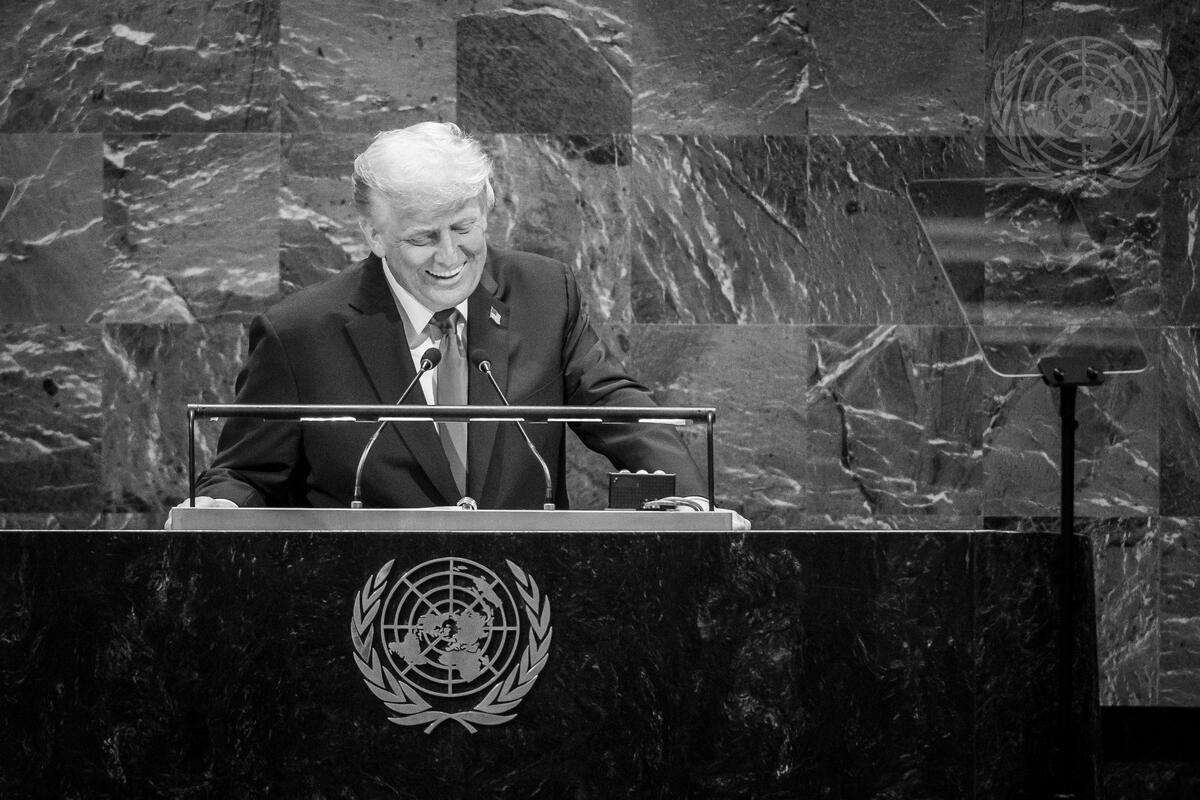
Trump renews climate change denial at the UN General Assembly
On September 23, the President of the United States addressed the UN General Assembly. For nearly an hour, he disparaged the institution on multiple issues and, as expected, attacked renewable energy while once again denying the scientific consensus on climate change. Many of his statements were unfounded or outright false. Fact-checking them is crucial to safeguard human health and the environment.
Renewable energy facts versus political rhetoric
- Trump called renewable energy “a hoax,” claiming it is unreliable, too expensive, and ineffective.
The evidence shows the opposite. In 2024, renewables and nuclear accounted for 80% of the increase in global electricity demand (+1,100 TWh). That same year, renewable energy costs saved the world $467 billion in fossil fuel expenses.
The International Renewable Energy Agency (IRENA) confirmed that 91% of new renewable capacity added in 2024 delivered cheaper electricity than even the lowest-cost fossil fuel alternatives. Research from Boston University’s Institute for Global Sustainability showed that solar power outperforms nuclear, hydrogen, and carbon capture in both cost efficiency and deployment speed.
Europe’s renewable path is not a setback
- Trump claimed that Europe is suffering financially because of its renewable strategy and that Germany abandoned its clean energy goals.
This is false. European Commission President Ursula von der Leyen explained that after Russia’s invasion of Ukraine triggered an energy crisis, Europe doubled investments in renewables, a decision that proved both effective and cost-efficient.
In 2024, renewables provided 59% of Germany’s electricity. The government remains committed to reaching 80% by 2030, as confirmed by Energy Minister Katherina Reiche when presenting Germany’s national energy transition monitoring report.
Denying climate science
- Trump said UN projections on the impacts of climate change are exaggerated, calling climate change “the greatest hoax ever perpetrated.”
These claims contradict every leading scientific authority. The IPCC concluded that human activities, mainly greenhouse gas emissions, have unequivocally caused global warming. Fossil fuels and heavy industry have made heat waves more frequent and severe.
A recent survey gathered the views of 380 authors who contributed to different sections of the IPCC reports. The assessments of the world’s leading climate science body are the foundation for global climate policy. Yet 77 out of 100 scientists believe the world will not even manage to stay below 2.5°C of warming, a threshold that would have catastrophic consequences for the planet and for human life. A University of Geneva study published in Nature showed that climate change skepticism, often amplified by Trump, spreads more effectively than scientific facts. This misinformation may fuel political popularity but harms humanity’s future.
Clean energy creates jobs
- Trump argued that cutting carbon emissions destroys jobs.
The data show the opposite. Clean energy transition requires new skills, but it is already generating large-scale employment. By the end of 2023, SolarPower Europe reported that the EU solar sector employed 826,000 people, up 27% from 2022. In the UK, onshore wind supports 18,000 jobs, with government plans to expand that to 45,000 by 2030.
In Italy’s auto sector, research by ECCO and T&E found that delaying the switch to electric vehicles could cost 94,000 jobs by 2035. In the U.S., clean energy jobs grew by 2.8% in 2024, more than triple the national employment growth rate of 0.8%.
“Clean, beautiful coal” is a myth
- Trump instructed his staff never to say the word “coal” alone but instead to call it “clean, beautiful coal.”
Coal is neither clean nor beautiful. A report by think tank Ember revealed that methane emissions from coal mines are twice as high as previously believed. Methane is a greenhouse gas 82.5 times more potent than CO2 over its first 20 years in the atmosphere.
Also read: Energy transition, five scenarios to 2060 between fossil resilience and renewable acceleration
