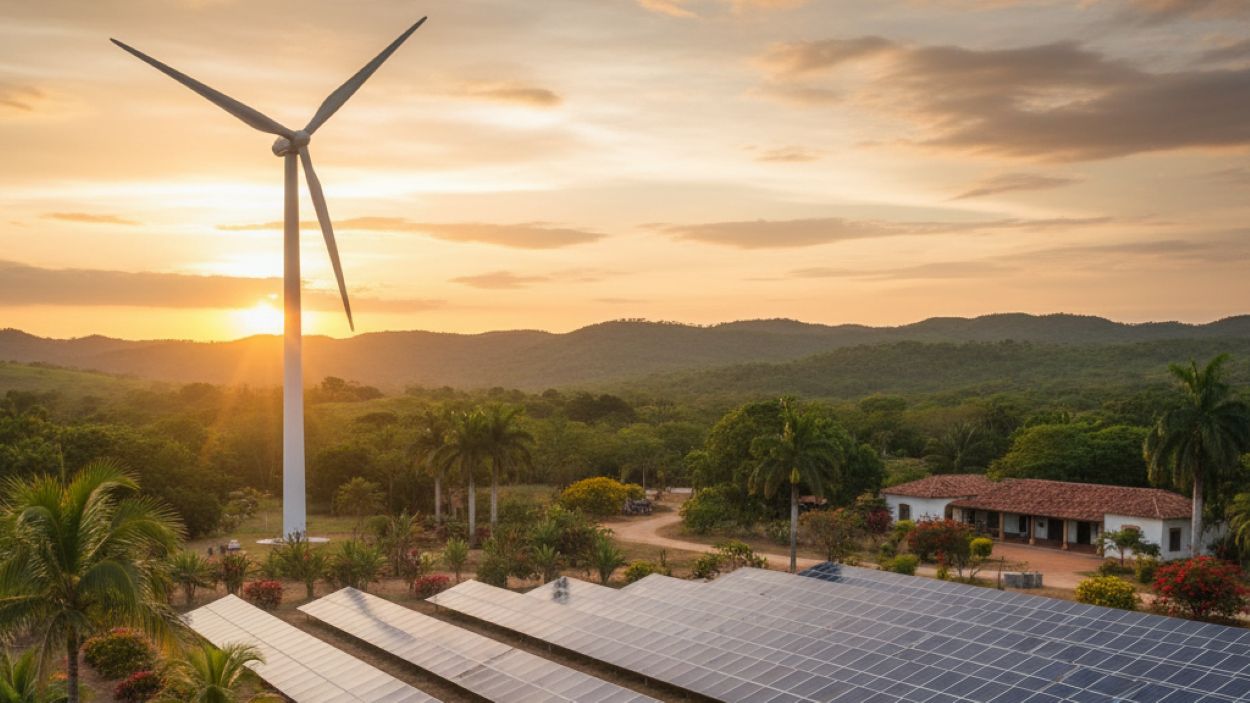
The energy transition in South America is now worth $58 billion a year
The energy transition in South America currently amounts to $58 billion per year. It stands as one of the continent’s most ambitious challenges, but also an unprecedented opportunity for economic growth and energy independence. According to the new Regional Energy Transition Outlook released by the International Renewable Energy Agency (IRENA) during COP30 in Belém, the region must attract $500 billion in renewable investments annually until 2050 to meet climate and sustainable development goals, a major leap from the $58 billion invested in 2024. In return, it could achieve an average 1.1% annual GDP increase and create more than 12 million energy-sector jobs.
Green growth as a driver of prosperity
IRENA’s analysis shows that decarbonizing South America’s energy system is both technically feasible and economically advantageous. The cost of solar power has dropped from $0.417 to $0.043 per kWh between 2010 and 2024, while onshore wind has fallen to $0.034 per kWh. With renewables already supplying nearly 80% of its electricity, South America is among the world’s most competitive regions and could reach 98% renewable power generation by 2050.
Achieving this target requires installing 55 GW of new capacity each year, more than double the current pace, focused on solar, wind, modern grids, storage systems, and cross-border interconnections.
$13 trillion in total investments to 2050
The success of the energy transition in South America depends on its vast natural and critical mineral resources. From Bolivia to Chile and Brazil to Argentina, the continent’s abundance of lithium, copper, and rare earth elements could make it a global hub for clean technology manufacturing. IRENA estimates total required investments at $13 trillion between 2025 and 2050, with a focus on grids, storage, efficiency, and local industry.
Reducing financing costs will be key: in some countries, the weighted average cost of capital (WACC) exceeds 15%, accounting for up to 70% of levelized energy costs. IRENA proposes regional mechanisms to mitigate risks and integrate electricity markets, creating a unified South American system.
Bioenergy and biofuels to supply one-third of energy demand by 2050
Sustainable biofuels remain central to South America’s decarbonization strategy, with Brazil maintaining global leadership. IRENA projects that regional bioethanol and biodiesel output could reach 97 billion liters by 2050, more than double current levels, meeting 33% of final energy demand.
Road transport will see growing adoption of electric, flex-fuel, and advanced-fuel vehicles: by 2040, over 40% of the fleet will be electric, while biodiesel and bioethanol will supply over 25% of the sector’s energy demand. Aviation and shipping will also rely on sustainable aviation fuels (SAF) and biogas, reinforcing South America’s role as a low-emission fuel exporter and strengthening rural economies.
22 million tons of green hydrogen by 2050
With abundant solar and wind resources, South America is poised to become a major green hydrogen producer. IRENA forecasts output reaching 22 million tons (MtH₂eq) by 2050, around 4% of global supply, supported by 260 GW of electrolysis capacity. Hydrogen and its derivatives such as ammonia will serve both domestic industries, like steel and fertilizer, and export markets. Yet this expansion will require an additional 1,300 TWh of electricity, making grid planning and renewable integration essential.
Shared strategy for critical minerals and renewable fuels
IRENA urges the 13 South American nations to coordinate governance, infrastructure, and workforce development. Cross-border grid planning, harmonized auction systems, and joint strategies for critical minerals and renewable fuels are essential for regional competitiveness.
The agency also calls for a regional hub for energy efficiency, retrofitting fossil infrastructure for renewable fuels, and fair fiscal policies that redirect subsidies from fossil fuels to clean technologies.
As IRENA Director-General Francesco La Camera emphasizes, “South America’s energy transition is not only unstoppable, it’s an unmissable opportunity to drive green industrialization and sustainable growth.”
Brazil to export up to 20% of its biofuels by 2050
Brazil illustrates the region’s leadership. The country already produces over 30 billion liters of bioethanol and nearly 10 billion liters of biodiesel, thanks to advanced technology and a widespread distribution network.
IRENA estimates that by 2050, Brazil could export up to 20% of its biofuels, expanding sustainable aviation fuel production and integrating biomethane into the natural gas grid. This would progressively replace fossil fuels in power generation and heating, combining economic progress, social inclusion, and lower emissions.
Toward an electric and inclusive future
IRENA’s roadmap outlines a clear vision: by 2050, South America could operate a near-fully decarbonized power system, with renewables representing 85% of primary energy and 98% of electricity generation.
But this transformation extends beyond technology, it demands political coordination, integrated planning, and workforce training. Only through cooperation can the region transform its natural wealth into sustainable prosperity and become a global model of a fair and inclusive energy transition.