
Climate finance commitments and the route to the 100 billion dollar milestone
An investigation by Carbon Brief and the Guardian shows that high income economies have directed billions of dollars toward climate related initiatives abroad. The analysis details how countries ultimately met the 100 billion dollar target for climate finance commitments.
How climate finance commitments are structured
Developed economies, including most of Europe, the United States, and Japan, are required under the Paris Agreement to provide international support to lower income countries for climate initiatives. Climate finance can take different forms, including grants, loans from multilateral development banks, and private investments. For more than a decade, the central goal of climate finance commitments was to mobilize 100 billion dollars per year by 2020. High income countries met that target in 2022, two years behind schedule.
Carbon Brief and the Guardian reviewed data from more than 20,000 climate related projects funded with public money by developed economies, including the latest official datasets for 2021 and 2022.
How countries reached the 100 billion dollar climate finance target
The findings offer a detailed overview of how advanced economies delivered the 100 billion dollar goal across different investment categories. The analysis shows that donor countries often rely on loans and private financing to meet their obligations toward lower income economies.
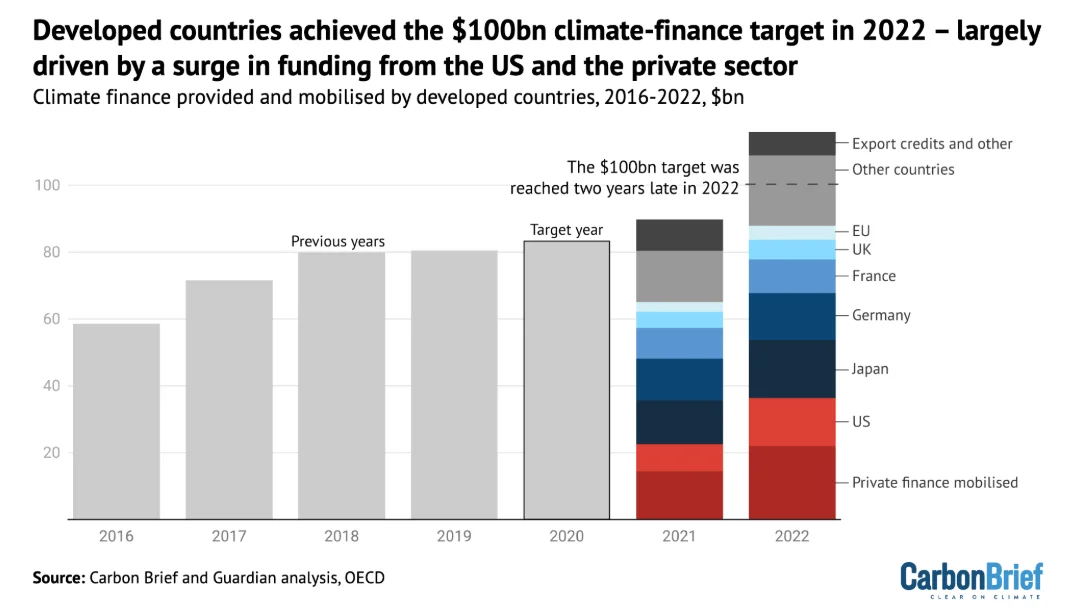
Meeting the 100 billion dollar target in 2022 was made possible largely through a surge in private capital and increased commitments from the United States government. A small group of nations has consistently remained the main source of climate finance. The trend held in both 2021 and 2022. Just four countries, Japan, Germany, France, and the United States, provided half of all climate finance commitments.
A 29 percent increase in climate finance in 2022
The year 2022 recorded the largest annual rise in climate finance. According to the Organisation for Economic Co operation and Development, climate related flows increased by 26.3 billion dollars, or 29 percent. Roughly half of that rise came from a 12.6 billion dollar increase in support from multilateral development banks, institutions financed by sovereign governments. The remaining growth came from two other main factors.
United States leads bilateral financing under Biden
The United States became the largest bilateral donor. Since Joe Biden took office in 2021, U.S. bilateral climate assistance has more than tripled across 2021 and 2022. In 2022, the combination of U.S. contributions and private investments pushed climate finance flows up by nearly 14 billion dollars, helping reach a total of 115.9 billion.
At COP29, high income countries committed to scaling climate finance to at least 300 billion dollars per year by 2035. The launch of the Baku Belém Roadmap could give COP30 an opportunity to revisit this pathway. However, prospects are increasingly uncertain. With Donald Trump returning to the White House, the U.S. government has cancelled American bilateral climate finance. Other major donors, including Germany, France, and the United Kingdom, have also cut aid budgets. This means additional climate finance in the coming years may depend heavily on expanding private sector funding.
What the analysis reveals about global climate finance commitments
Nearly 730 million people still lack access to electricity, and almost 80 percent live in sub Saharan Africa. Carbon Brief and the Guardian identified funding for more than 500 clean energy and electrification projects across African countries, totaling 7.6 billion dollars between 2021 and 2022. These projects included support for Chad’s first solar plant, a new hydropower facility in Mozambique, and the expansion of power grids in Nigeria.
For many lower income countries, loans remain the primary form of international climate finance. While they help fund major infrastructure, they are sometimes offered on unfavourable terms, worsening the debt burden of governments already facing high repayment pressures.
Wealthy Gulf states have also received climate related funds. The United Arab Emirates, for example, received 1.3 billion dollars in Japanese financing for an electric transmission project and a waste to energy facility.
According to the analysis, the largest recipients of international climate finance tend to be major middle income economies such as Egypt, the Philippines, and Brazil. India, in particular, received 14.1 billion dollars in 2021 and 2022, almost entirely through loans, making it the single largest beneficiary.